
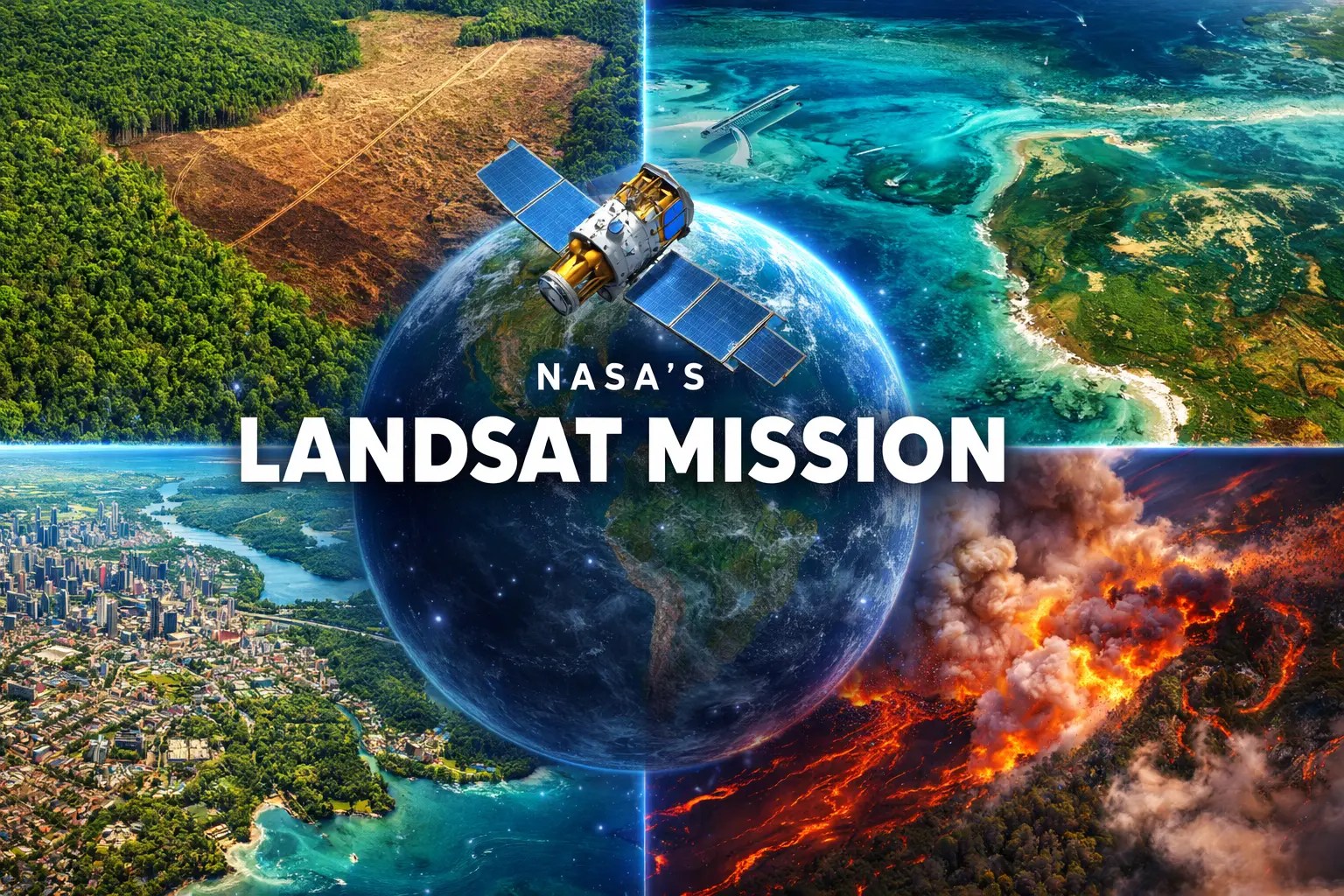
NASA’s Landsat Mission: 40 Years of Earth Observation
Continuous Record of Earth’s Changing Surface
NASA’s Landsat mission has been providing the world’s longest continuous record of Earth’s surface changes as seen from space. Since 1972, Landsat satellites have captured images of our planet, revealing the impacts of human activities and natural disasters on the environment.
The latest satellite in the Landsat series, Landsat 8, was launched in 2013 and continues the mission of tracking Earth’s surface changes. Landsat 8 carries sensors with even higher precision than its predecessors, allowing for more detailed and accurate monitoring of environmental changes.
Landsat 8: The Landsat Data Continuity Mission
Landsat 8, also known as the Landsat Data Continuity Mission, is a large spacecraft that orbits Earth at an altitude of about 700 kilometers. It is equipped with sensors that capture instantaneous views of a 185-kilometer swathe of Earth, using 7,000 sensors for each bandwidth.
Landsat 8 replaced the aging Landsat 5 and Landsat 7 satellites, which had been providing valuable data for decades but were nearing the end of their operational lives. Landsat 5 had served for nearly three decades, far exceeding its original design life of three years.
Tracking Earth’s Surface Changes
The Landsat mission plays a crucial role in tracking changes in Earth’s surface, including:
- Water and forest cover
- Urbanization
- Deforestation
- Natural disasters (e.g., earthquakes, hurricanes)
- Climate change impacts (e.g., melting glaciers, sea level rise)
Landsat data is used by scientists, policymakers, and land managers to understand and address environmental issues, such as climate change, water scarcity, and deforestation.
Gap in the Landsat Record
A gap in the Landsat data record would be devastating for environmental monitoring. In 1993, the Landsat 6 satellite failed to reach orbit, resulting in a gap in the record. A similar gap could occur if Landsat 8 fails or if a replacement satellite is not launched in time to maintain continuity.
Landsat: Art and Science
In addition to its scientific value, Landsat images have also captured the public’s imagination. The United States Postal Service has released a stamp series based on some of the Landsat satellite’s stunning images. Landsat images are also used in art, education, and public outreach to raise awareness of environmental issues.
Landsat 8 Launch and Live Stream
Landsat 8 was launched from Vandenberg Air Force Base in California on February 11, 2013, at 10 am PST (1 pm EST). You can follow the Landsat mission on Twitter or watch the launch live on NASA’s website.
Landsat’s Legacy
The Landsat mission has revolutionized our understanding of Earth’s surface and the changes it is undergoing. Landsat data has been used to monitor deforestation in the Amazon rainforest, the retreat of glaciers in Antarctica, and the growth of urban areas around the world.
As Landsat 8 continues its mission, it will provide even more valuable data for scientists and policymakers to address the environmental challenges of the 21st century.
