
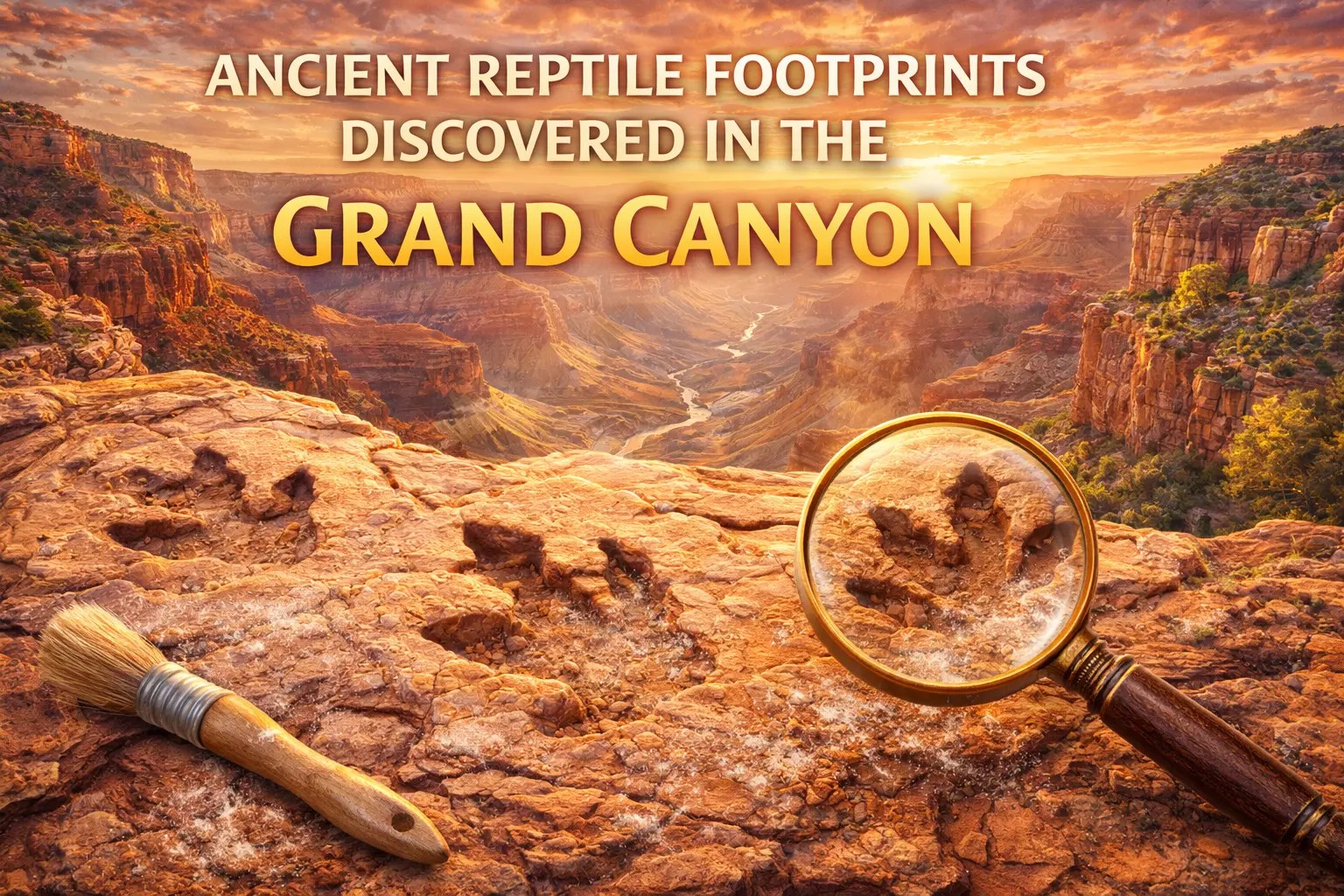
Prehistoric Reptile Footprints Unearthed in Grand Canyon
Discovery and Significance
In 2016, geologist Allan Krill stumbled upon an intriguing discovery while exploring the Bright Angel Trail in Grand Canyon National Park. Etched into a large sandstone boulder were a series of indentations that resembled ancient footprints. These markings turned out to be fossilized tracks, the oldest vertebrate fossil tracks ever found in the park.
Paleontologist Stephen Rowland, who examined the footprints, estimated their age at approximately 313 million years old. This remarkable find not only sheds light on the evolution of early vertebrates but also provides the earliest evidence of amniotes, hard-shelled-egg-laying animals, in the world.
The Fossilized Tracks
The track-bearing boulder, weighing hundreds of pounds, had fallen from the Manakacha Formation, a sandstone deposit that formed around 314 million years ago. The tracks were formed when the sandy surface became wet and then dried, preserving the imprints for millions of years.
Two distinct sets of tracks are visible on the boulder’s surface. The first set belongs to an animal that walked slowly using a “lateral sequence walk,” where the limbs move in a specific pattern for stability. The second set of tracks indicates a slightly faster pace.
Insights into Early Vertebrate Life
The study of the footprints has provided valuable insights into the behavior and environment of early vertebrate animals. The lateral sequence walk observed in one of the animals is a gait commonly used by living tetrapods, such as dogs and cats, when walking slowly. This discovery suggests that this gait evolved early in vertebrate history.
Furthermore, the presence of amniote footprints in sand dunes pushes back the known timeline for amniotes living in such habitats by at least 8 million years. This finding adds to our understanding of the diversification and adaptation of early vertebrates.
Controversy and Excitement
Mark Nebel, the paleontology program manager at the Grand Canyon, notes that some aspects of the study’s conclusions may be subject to scientific debate, particularly regarding the interpretation of the tracks and the age of the rocks. However, he emphasizes the excitement surrounding the discovery, as it reveals new information about the prehistoric world and challenges our understanding of early vertebrate evolution.
Conclusion
The discovery of ancient reptile footprints in the Grand Canyon has opened a window into the distant past, providing valuable insights into the origins and behavior of early vertebrates. The study continues to generate discussion and research, further enriching our knowledge of these fascinating creatures.
