
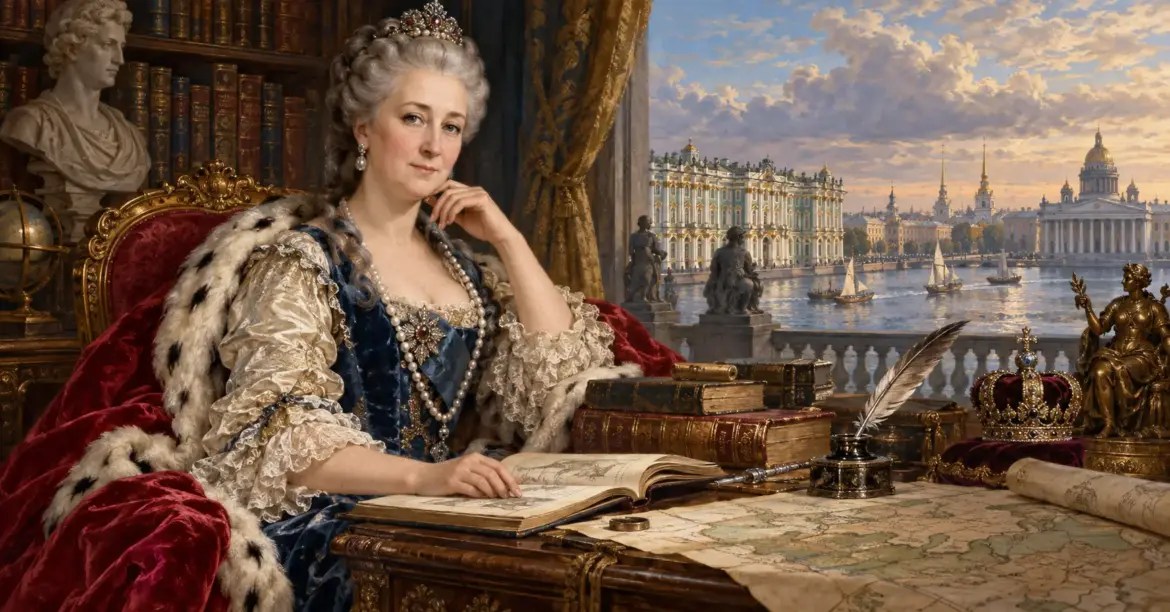
Catherine the Great: The Enlightened Despot
Early Life and Accession to Power
Catherine the Great, born Sophia of Anhalt-Zerbst, was a Prussian princess who became Empress of Russia in 1762. Her rise to power was marked by ambition and ruthlessness. She staged a coup against her husband, Peter III, with the support of her lover, Grigory Orlov, and her powerful family. Catherine’s accession to the throne was a pivotal moment in Russian history, as she embarked on a reign marked by both progress and contradictions.
Enlightened Reforms and Accomplishments
Catherine was a dedicated advocate of the Enlightenment ideals. She believed in the principles of reason, education, and progress. Her reign saw significant reforms in the areas of law, administration, and education. She drafted the Nakaz, or Instruction, a comprehensive legal code that aimed to modernize Russian law and abolish serfdom. While the Nakaz was never fully implemented, it demonstrated Catherine’s commitment to Enlightenment principles.
Catherine also played a central role in expanding the Russian Empire. She led successful military campaigns against the Ottoman Empire, Sweden, and Poland, significantly increasing Russia’s territory and influence. These conquests earned her the title “the Great.”
Cultural Patronage and Legacy
Catherine’s passion for culture and the arts left an enduring legacy on Russia. She was an avid collector of paintings, sculptures, and books, and her patronage helped establish the Hermitage Museum in St. Petersburg as one of the world’s greatest art repositories. She commissioned numerous architectural projects, including neoclassical palaces and the imposing Bronze Horseman statue of Peter the Great. Catherine’s cultural endeavors transformed Russia into a major center of European culture and refinement.
Personal Life and Misconceptions
Catherine’s personal life has been the subject of much speculation and controversy. She is often portrayed as a promiscuous woman with an insatiable sexual appetite. However, historians argue that this image is largely based on exaggerated rumors and political propaganda aimed at discrediting her. While Catherine did have several lovers, she was not the deviant depicted in popular lore.
Contradictions and Challenges
Despite her accomplishments, Catherine’s reign was not without its contradictions. Her commitment to Enlightenment ideals clashed with the reality of Russian society, which was still dominated by serfdom and autocracy. Catherine recognized the need for reform, but she feared alienating the powerful nobility who supported her rule. This tension between progress and tradition shaped her legacy as an enlightened despot.
Succession and Legacy
Catherine’s death in 1796 marked the end of an era in Russian history. She was succeeded by her son, Paul I, who reversed many of her reforms and pursued a more conservative and repressive agenda. Catherine’s legacy remains complex and contested. She is celebrated as an enlightened ruler who modernized Russia, but she is also criticized for her autocratic tendencies and her failure to abolish serfdom.
Catherine the Great: A Historical Enigma
Catherine the Great was a woman of contradictions, a visionary reformer who nonetheless presided over a society marked by inequality and oppression. Her reign left an enduring mark on Russia, shaping its culture, borders, and political system. Understanding Catherine’s complexities requires an examination of her accomplishments, her personal life, and the challenges she faced as a female ruler in a turbulent时代.