
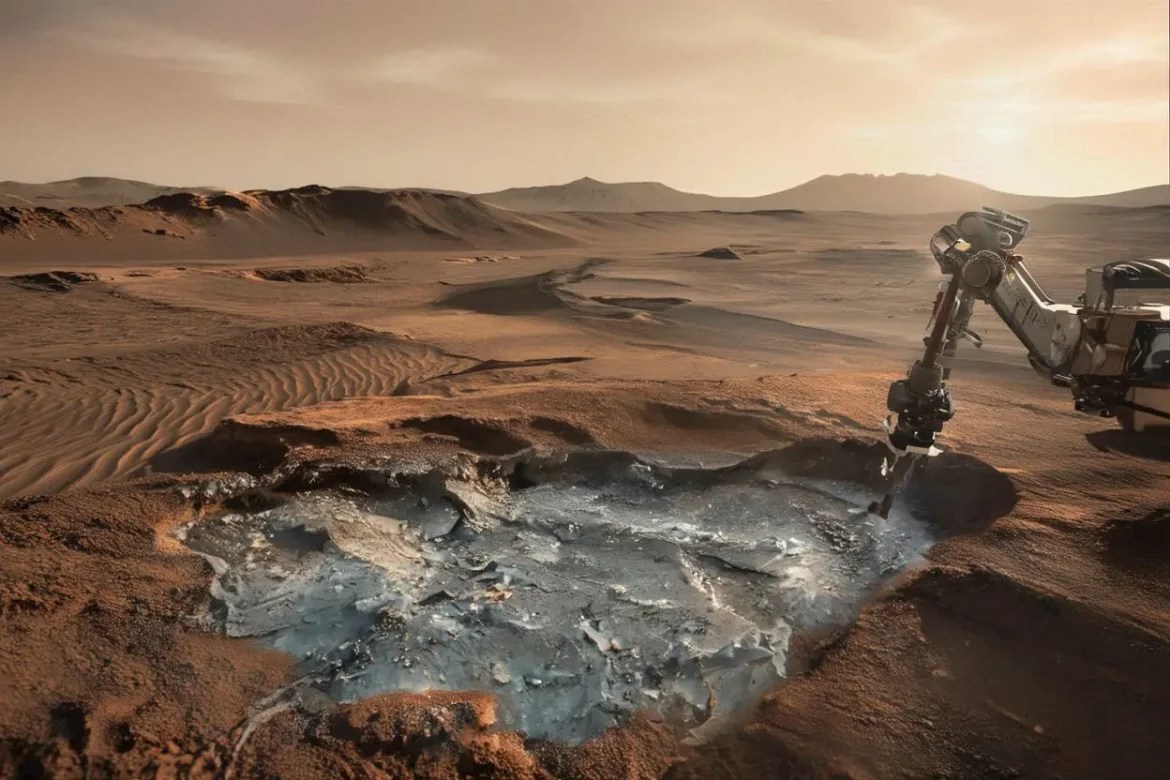
Subsurface ‘Lakes’ on Mars May Be Frozen Clay Deposits
The Search for Liquid Water on Mars
The search for evidence of past life on Mars has led to numerous studies investigating the possibility of liquid water still existing on the planet. In recent years, several studies have suggested that liquid water could be found beneath layers of ice at the Martian south pole.
Radar Detection of Underground Lakes
One of the most compelling pieces of evidence for liquid water on Mars came from data collected by the Mars Advanced Radar for Subsurface and Ionosphere Sounding (MARSIS) instrument aboard the European Space Agency’s Mars Express Orbiter. The radar detected strong and bright signals from the planet, which is an effect commonly attributed to the presence of water.
Challenges with Liquid Water Hypothesis
However, Mars is an extremely cold planet, with temperatures averaging minus 81 degrees Fahrenheit. This raises questions about how liquid water could exist in such extreme conditions. Some scientists have proposed that the water could be infused with large amounts of salt or warmed by geothermal activity. However, studies have shown that neither of these scenarios is likely at the Martian south pole.
Alternative Hypothesis: Frozen Clay Deposits
A new study published in the journal Geophysical Research Letters proposes an alternative hypothesis: the bright radar signals detected by MARSIS may not be from liquid water but rather from frozen clay deposits known as smectites. Smectites are a type of clay that forms when volcanic rocks interact with water and retain a significant amount of water within their structure.
Evidence for Smectites on Mars
The researchers analyzed smectites and found that they could generate radar reflections similar to those detected by MARSIS, even when mixed with other materials. They also found evidence of smectites along Mars’s south pole after analyzing visible and infrared light data collected from the region.
Implications for Understanding Mars
The discovery of smectites on Mars has implications for our understanding of the planet’s history and potential for habitability. The presence of clay minerals suggests that the Martian south pole was once warm enough to support liquid water. Over time, the clay was buried under ice and preserved in its frozen state.
Future Research
To confirm the presence of smectites and determine the nature of the subsurface deposits at the Martian south pole, researchers will need more sophisticated instruments capable of directly sampling the materials. Future studies will also investigate the diversity of clay minerals on Mars and their potential role in the planet’s geological processes.
Exploring the Martian Subsurface
The search for evidence of liquid water and habitable environments on Mars continues to be a key focus of planetary exploration. By studying the subsurface deposits at the Martian south pole, scientists hope to gain a better understanding of the planet’s past and present conditions, and its potential for supporting life.