
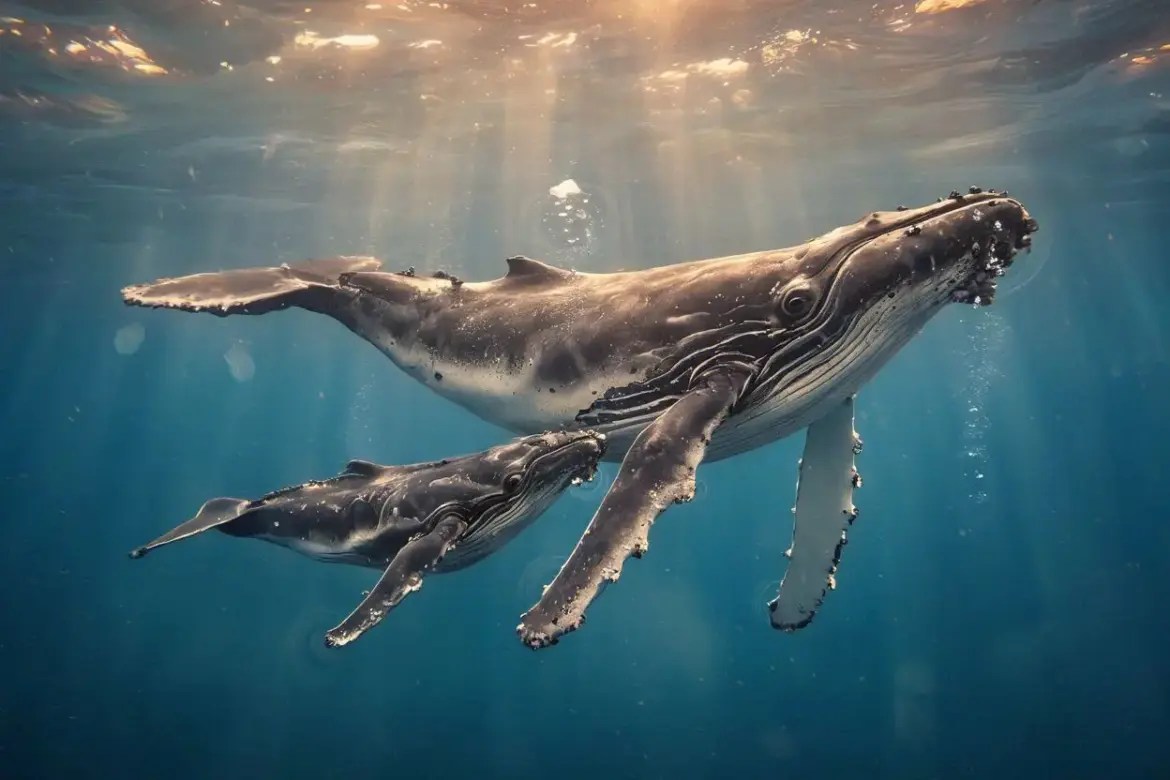
Mother and Baby Humpback Whales Communicate in Whispers to Avoid Predators
Humpback whales are massive creatures, reaching up to 50 feet in length. However, their newborn calves are much smaller, measuring only about 15 feet at birth. This makes them vulnerable to predators, such as killer whales, which often target young whales.
To protect their calves from danger, mother humpback whales have developed a unique communication strategy: whispering. Researchers have discovered that mother and baby humpbacks emit faint squeaks and grunts that can only be heard about 330 feet away. These vocalizations are much quieter than the calls of male humpbacks, which can be detected kilometers away.
This whispering behavior serves several purposes. First, it helps to hide the presence of the calf from killer whales. Killer whales rely on sound to locate their prey, so the quieter vocalizations of mother and baby humpbacks make it more difficult for them to be detected.
Second, whispering may also help to keep mother and baby whales hidden from randy male humpbacks. Male humpbacks are often aggressive towards females with calves, and they may try to interrupt nursing time. By whispering, mother and baby humpbacks can avoid attracting the attention of these unwanted suitors.
However, the researchers also found that if an orca does manage to hear the quiet sounds of a mother and baby humpback, it can use the noise as a homing beacon to locate its prey. This suggests that whispering is not a foolproof defense against predators, but it does provide some level of protection.
The Role of Whispering in Humpback Whale Communication
In addition to helping to avoid predators, whispering may also play a role in other aspects of humpback whale communication. The researchers found that calves only made the faint vocalizations while swimming, which suggests that they may be using the sounds to help their mothers keep track of them, especially in murky waters.
Whispering may also be used for communication between mother and calf during nursing. The researchers observed that the calves would often make the faint vocalizations while nursing, and the mothers would respond with similar sounds. This suggests that the calves may be using the sounds to communicate their hunger or other needs to their mothers.
The Impact of Ship Noise on Humpback Whale Communication
The discovery of whispering in humpback whales has important implications for the conservation of these animals. Ship noise is a major source of pollution in the oceans, and it can interfere with the communication of whales and other marine life.
The researchers found that ship noise can mask the faint vocalizations of mother and baby humpbacks, making it difficult for them to communicate. This could have a negative impact on the survival of calves, as they may not be able to stay close to their mothers or find food.
The Importance of Quieting Human Impact on the Environment
The findings of this study underscore the importance of quieting human impact on the environment. Ship noise is just one of many human activities that can disrupt the communication of whales and other marine life.
We need to take steps to reduce ship noise and other forms of ocean noise pollution. We can also support research on the communication of whales and other marine animals to better understand how we can minimize our impact on their ability to communicate.
By quieting human impact on the environment, we can help to protect whales and other marine life and ensure their survival for future generations.