
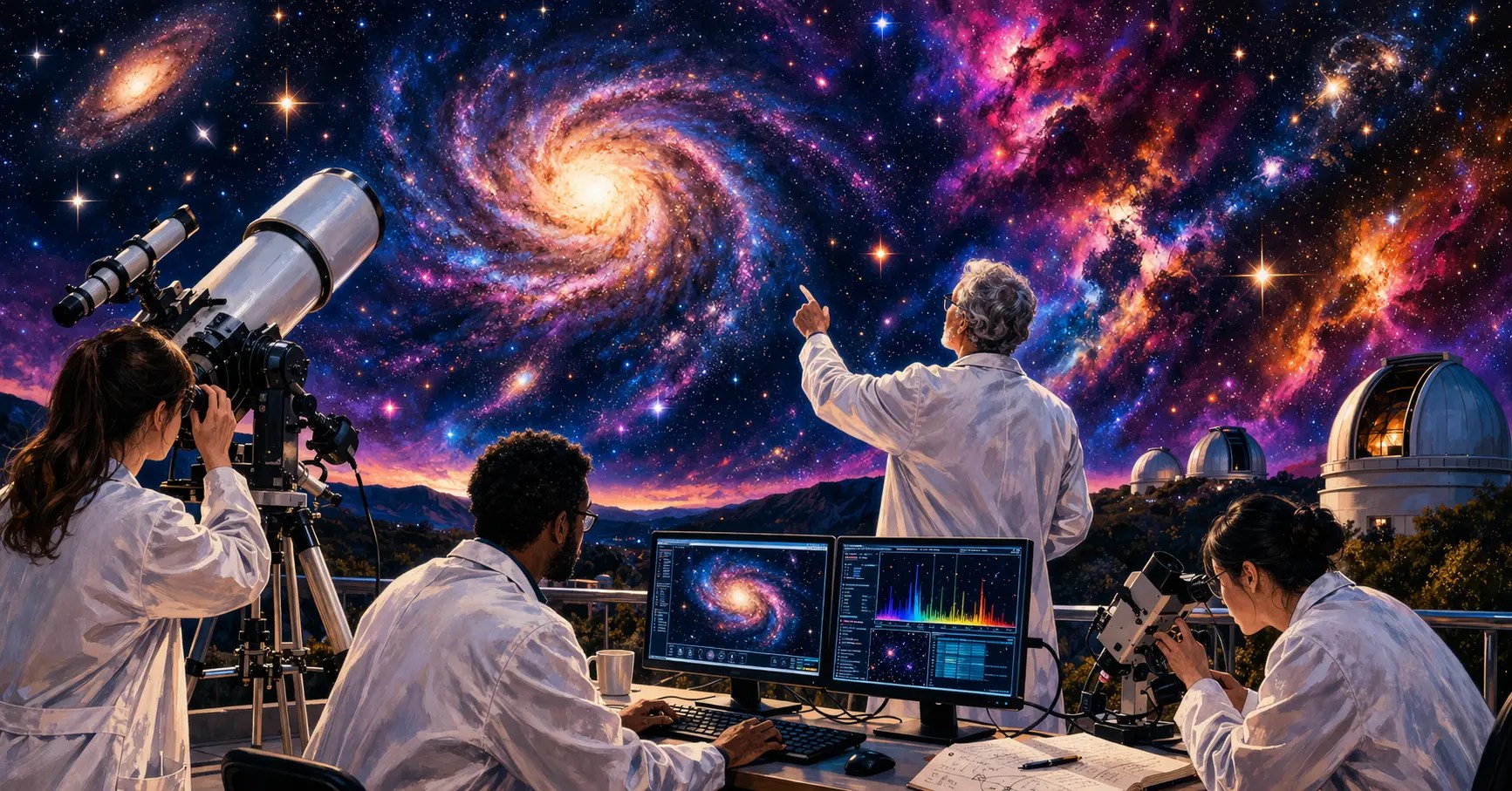
The Nobel Prize in Physics: Mapping Our Place in the Cosmos
Cosmology: Unraveling the Structure of the Universe
James Peebles, a pioneering cosmologist, has been awarded half of the Nobel Prize in Physics for his groundbreaking work on the structure of the universe. Peebles’ theories have helped scientists understand the composition and evolution of our cosmos.
In the 1960s, cosmologists had a limited understanding of the universe. They knew it was vast, but they didn’t know how far away objects were, how old it was, or how it was structured. Peebles set out to answer these questions using theoretical models and observational data.
One of Peebles’ key contributions was his prediction of the cosmic background radiation, a remnant of the early universe that pervades the entire cosmos with almost constant radiation. He also proposed that by studying minute variations in the background radiation, astronomers could find areas where matter was clumped together. This led to the discovery of the large-scale structure of the universe, which is made up of filaments of stars, galaxies, and clusters of galaxies.
In the 1980s, Peebles added dark matter to the mix. Dark matter is a mysterious substance that does not emit or reflect light, but its gravitational effects can be observed. Peebles proposed that dark matter explains why galaxies clump together despite their lack of visible mass. He also suggested that the universe was expanding and that expansion was accelerating due to the force of dark energy.
Peebles’ theories were gradually confirmed by advancing technology. In the 1990s, researchers found that fluctuations in the background radiation did correspond to clumps of matter. In 1998, astronomers confirmed that the universe is expanding and accelerating. Dark matter and dark energy, however, remain unexplained, but researchers are diligently investigating these concepts.
Exoplanets: Unveiling New Worlds
The other half of the Nobel Prize in Physics was awarded to Michael Mayor and Didier Queloz for their discovery of the first exoplanet, a planet outside our solar system. In the early 1990s, astronomers had not yet found any planets orbiting other stars, despite decades of searching.
Queloz, then a graduate student working with Mayor, developed software that looked for tiny wobbles in the light and color of stars. These wobbles could indicate that the gravity of an orbiting planet was affecting the star, shifting the wavelengths of light.
After observing 20 bright stars, the software detected a wobble in the star 51 Pegasi, 51 light years away. Queloz and Mayor spent months confirming their data before announcing their discovery in October 1995. They had found the first true exoplanet, a Jupiter-sized planet around 51 Pegasi.
The discovery of 51 Pegasi b revolutionized astronomy. Since then, astronomers have discovered over 4,000 exoplanets in the Milky Way, ranging in size, composition, and orbit. These discoveries have given scientists new insights into the formation and evolution of planetary systems and have raised the possibility of finding extraterrestrial life.
Impact of the Nobel Prize Winners’ Work
The work of James Peebles, Michael Mayor, and Didier Queloz has had a profound impact on our understanding of the universe. Peebles’ theories have helped us to understand the structure and evolution of the cosmos, while Mayor and Queloz’s discovery of the first exoplanet has opened up new frontiers in astronomy and the search for extraterrestrial life.
The Nobel Prize in Physics is a testament to the groundbreaking contributions of these scientists and their dedication to unraveling the mysteries of the universe.
