
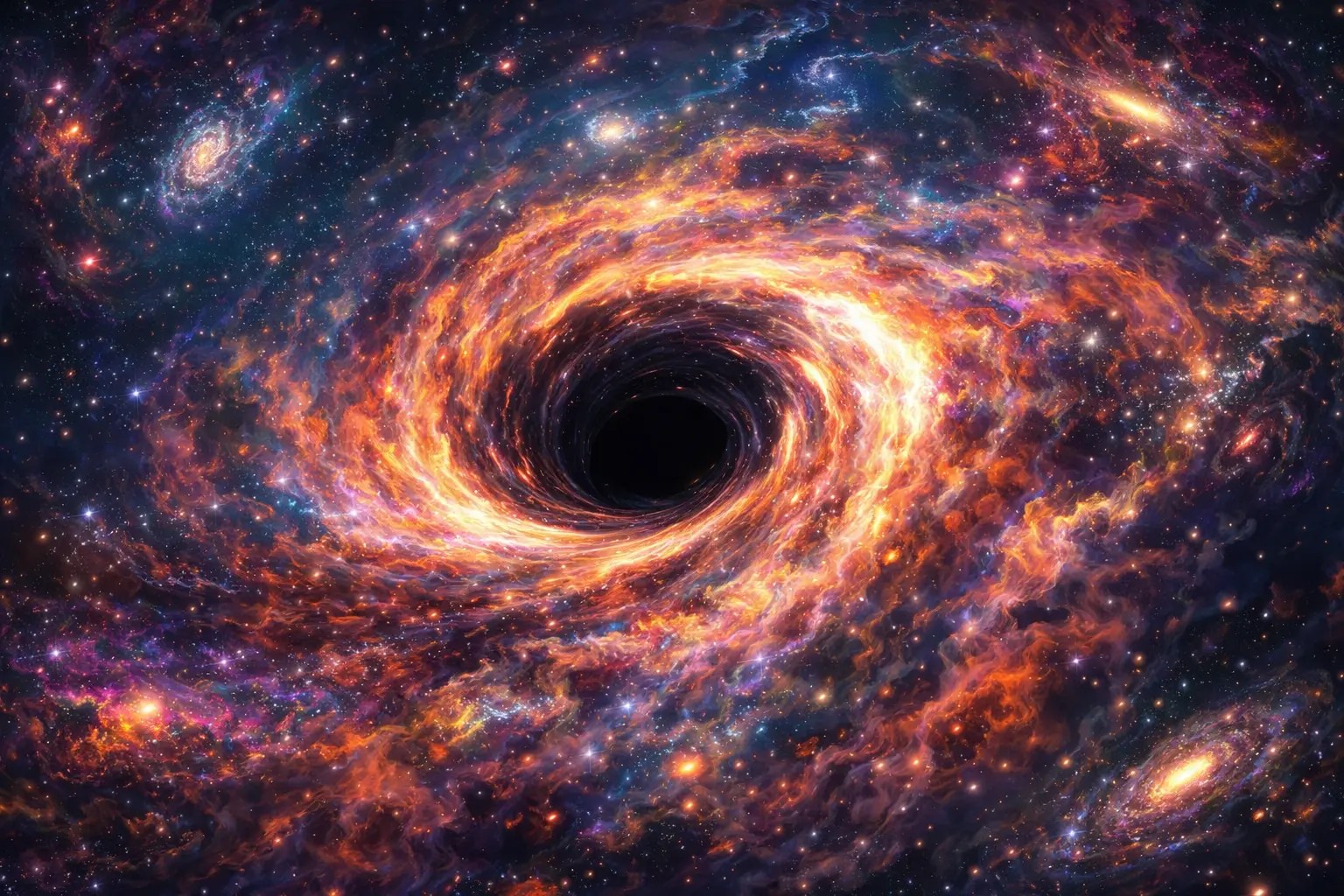
Oldest Black Hole Ever Detected Sheds Light on Early Universe
Discovery and Significance
Astronomers have made a groundbreaking discovery: the oldest black hole ever observed, dating back to just 470 million years after the Big Bang. This ancient cosmic structure provides valuable insights into the formation of the first black holes and the early universe.
Characteristics of the Black Hole
The black hole, located within the galaxy UHZ1, is exceptionally massive, weighing between 10 million and 100 million times more than our sun. Its discovery challenges previous theories about the formation of supermassive black holes.
Observational Techniques
Scientists used two powerful space telescopes to detect the black hole. The James Webb Space Telescope identified 11 distant galaxies, while the Chandra X-Ray Observatory detected X-ray emissions from the black hole within UHZ1.
Implications for Black Hole Formation
The discovery supports the theory that some supermassive black holes originated as “heavy seeds,” forming from the collapse of massive gas clouds rather than evolving from smaller black holes over time.
The Early Universe
The ancient black hole provides a window into the conditions of the universe shortly after its birth. It suggests that massive black holes may have played a crucial role in shaping the early galaxies and influencing the evolution of the cosmos.
Ongoing Research
While the discovery of this single black hole provides valuable insights, scientists emphasize the need for further research to understand the origins of supermassive black holes and their role in the evolution of the universe.
Additional Details
- The black hole’s X-ray emissions indicate its immense energy and gravitational pull.
- The study, published in the journal Nature Astronomy, has sparked excitement among astronomers worldwide.
- Scientists continue to explore the mysteries of black holes and their impact on the universe.
Black Hole Formation Theories
Astronomers have proposed two main theories for the formation of supermassive black holes:
- Stellar Mass Black Holes: These black holes form from the collapse of massive stars.
- Heavy Seed Origin: Supermassive black holes form directly from the collapse of gargantuan gas clouds, bypassing the stellar mass stage.
The discovery of the ancient black hole in UHZ1 supports the heavy seed origin theory, indicating that these massive objects existed in the early universe.
Impact on Galaxy Evolution
Supermassive black holes are believed to play a key role in the evolution of galaxies. Their gravitational influence can:
- Shape the distribution of stars and gas within galaxies.
- Trigger bursts of star formation.
- Expel gas from galaxies, quenching star formation.
The presence of a massive black hole in the early universe suggests that these objects may have influenced the formation and evolution of the first galaxies.
Future Studies
Astronomers plan to continue studying the black hole in UHZ1 and other ancient black holes to:
- Determine their frequency and distribution in the early universe.
- Investigate their role in galaxy formation and evolution.
- Gain insights into the physical processes that shape the universe.
