
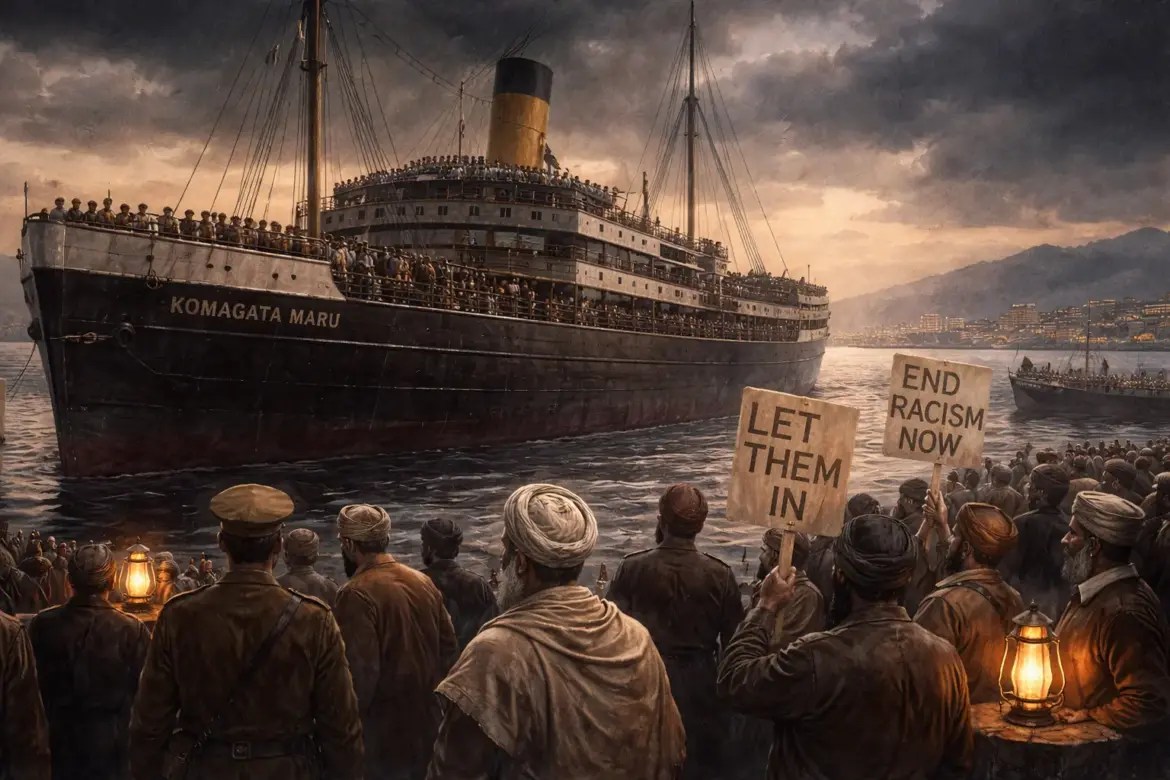
The Komagata Maru Incident: A Stain on Canada’s History
Background:
Over a century ago, in 1914, a Japanese steamship named the Komagata Maru arrived in Vancouver’s harbor carrying hundreds of Sikh immigrants from India. However, the ship was denied entry, and most of its passengers were barred from stepping foot on Canadian soil.
Racism and Discrimination:
The denial of entry to the Komagata Maru was rooted in rampant racism and discrimination against immigrants from Asia. White Canadians feared competition for jobs and harbored nativist sentiments. The Canadian government had implemented strict immigration policies, such as the Continuous Passage Act, which made it extremely difficult for immigrants from Asia to enter the country.
The Komagata Maru’s Journey:
The Komagata Maru was chartered by Gurdit Singh, a Sikh activist who believed that British subjects should be allowed to travel freely within the Empire. The ship sailed from Hong Kong with over 350 passengers, many of whom were farmers and laborers.
Hostility and Violence:
As the Komagata Maru approached Vancouver, the press whipped up anti-immigrant sentiment among white Canadians. The premier of British Columbia, Sir Richard McBride, openly admitted that the decision to bar the passengers was motivated by racism. Despite protests from Canadians of Indian descent, the ship was forced to remain anchored in the harbor for two months.
Return to India and Tragedy:
After failing to gain entry to Canada, the Komagata Maru was forced to return to India. However, the aftermath was even more tragic. The Indian colonial government used the incident as a pretext to pass repressive border control laws. Upon the ship’s arrival in Calcutta, authorities attempted to arrest suspected Sikh radicals, sparking a brutal riot that left 19 people dead.
Trudeau’s Apology:
In 2016, Canadian Prime Minister Justin Trudeau issued a formal apology for the treatment of the Komagata Maru passengers. The apology was seen as a significant step towards acknowledging and addressing the racism and prejudice that had marred Canada’s past.
Legacy and Lessons Learned:
The Komagata Maru incident remains a shameful chapter in Canadian history, serving as a reminder of the devastating consequences of discrimination and prejudice. It highlights the importance of human rights, equality, and the need to combat racism in all its forms.
The Impact on Sikh Immigrants:
The Komagata Maru incident had a profound impact on Sikh immigrants in Canada. They faced ongoing discrimination and exclusion, and it was not until after India’s independence in 1947 that significant numbers of Sikhs were able to immigrate to Canada.
Modern-Day Implications:
The lessons learned from the Komagata Maru incident continue to resonate in modern-day society. They remind us of the importance of tolerance, diversity, and the need to create inclusive and welcoming communities for all.