
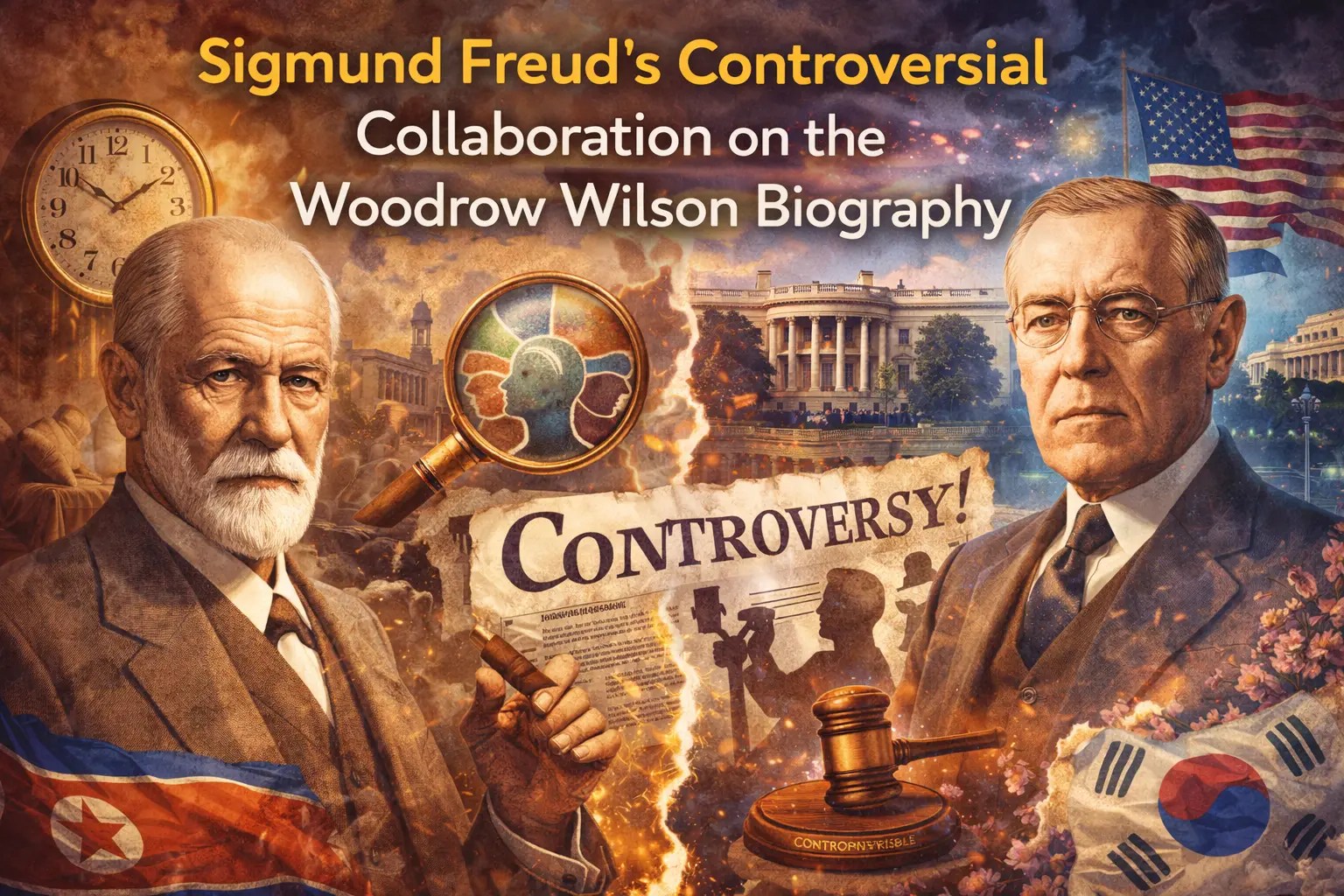
Sigmund Freud and the Controversial Woodrow Wilson Biography
The Collaboration
In the 1930s, renowned psychologist Sigmund Freud and American diplomat William Bullitt embarked on an unusual collaboration: a psychological biography of former US President Woodrow Wilson. Freud, known for his groundbreaking work in psychoanalysis, provided theoretical insights, while Bullitt, a former ambassador and journalist, contributed historical research and personal anecdotes.
The Book’s Controversial Content
The resulting book, titled “Thomas Woodrow Wilson: A Psychological Study,” caused a stir upon its publication in 1967. Critics accused Bullitt of exploiting Freud’s name to legitimize his own harsh judgments of Wilson, particularly his allegations of homosexuality and an Oedipus complex.
Freud’s Influence
Despite the controversy, evidence suggests that Freud played a significant role in shaping the book’s content. Freud’s handwritten additions, preserved in the Bullitt Papers, contain many of the passages that drew the most criticism. However, Bullitt rejected several of Freud’s more extreme claims, such as those linking Christianity to homosexuality.
Political Considerations
The publication of the Wilson book was delayed for decades due to political considerations. Bullitt’s diplomatic career would have been jeopardized by releasing a book that portrayed a former Democratic president in such a negative light. Only after Freud’s death did Bullitt agree to remove some of the more controversial passages.
Bullitt’s Role
While Freud’s contributions were substantial, Bullitt’s own research and writing should not be overlooked. His firsthand observations of Wilson and his contemporaries provide valuable insights into the political and personal dynamics of the time. Bullitt’s ability to translate psychoanalytic concepts into accessible prose made the book more engaging for a general audience.
The Rehabilitation of Bullitt’s Reputation
In recent years, there has been a growing recognition of Bullitt’s role in the Wilson biography. The discovery of Freud’s influence has helped to dispel the notion that Bullitt was solely responsible for the book’s controversial content.
The Historical Legacy
The Wilson book remains a fascinating and controversial piece of historical writing. It sheds light on the complex relationship between psychology and politics, and the enduring power of psychoanalytic theory. Despite its flaws, the book offers valuable insights into the character and presidency of Woodrow Wilson, as well as the intellectual and cultural climate of the early 20th century.
Additional Long-Tail Keywords:
- The role of psychoanalysis in understanding historical figures
- The tension between scientific objectivity and personal bias in biography
- The impact of political ideology on historical interpretation
- The enduring influence of Freud’s ideas on psychology and culture
- The importance of collaboration between scholars from different disciplines
