
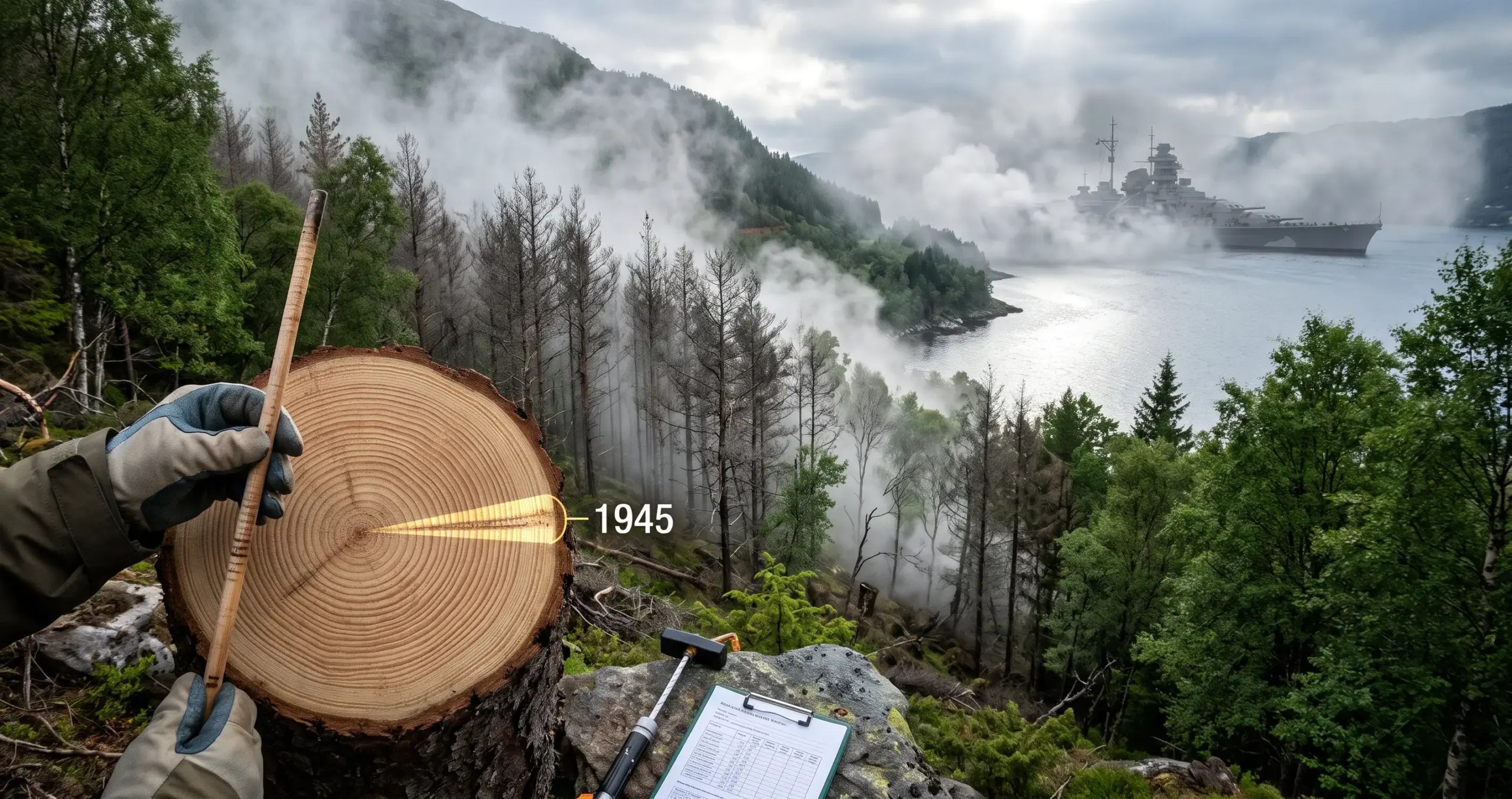
German Battleship Tirpitz Leaves Lasting Legacy in Norwegian Trees
Chemical Fog’s Impact on Tree Growth
During World War II, the German battleship Tirpitz hid in Norway’s fjords, using a chemical fog to camouflage its presence from Allied attacks. Now, scientists have discovered that this artificial smoke left a lasting impact on the surrounding trees.
Evidence in Tree Rings
Researchers led by dendrochronologist Claudia Hartl examined tree cores from Kåfjord, Norway, located near where the Tirpitz was anchored. They found that some trees completely lacked growth rings dating to 1945, the year the ship was destroyed.
Stunted Growth and Missing Rings
The smoke damage caused a period of stunted growth in pine and birch trees. In one tree, no new growth occurred for nine years after 1945. Other trees showed visible but very thin rings. The damage was most severe closer to Kåfjord and diminished with distance.
Chemical Fog’s Composition and Effects
The chemical fog used by the Tirpitz was composed of chlorosulphuric acid. This corrosive substance damaged the trees’ leaves and hindered their ability to photosynthesize and grow.
Rare Occurrence of Missing Rings
Absent growth rings in trees are rare, typically occurring only in extreme conditions such as severe drought. However, the total lack of rings in the Kåfjord trees could not be explained by these factors.
Tirpitz’s Influence on Tree Health
Hartl and her colleagues concluded that the missing growth rings were likely caused by the Tirpitz’s chemical fog. This discovery sheds light on the environmental impact of the battleship’s presence in Norway.
Potential for Wider Impact
Hartl believes that similar patterns of tree damage may exist in other parts of Europe where chemical smokescreens were used during World War II. Further research is needed to explore this possibility.
Historical Context
The Tirpitz was a formidable warship, and its presence in Norway posed a significant threat to the Allies. The use of chemical fog was a strategic tactic to evade detection and protect the ship from attacks.
Tirpitz Museum and Legacy
The Tirpitz’s history is showcased at the Tirpitz Museum near Kåfjord. The museum tells the story of the bunker that was built to protect the battleship but was never completed.
Environmental Impact Uncovered
While the Tirpitz’s military impact has been well-documented, its environmental legacy has gone largely unnoticed until now. The discovery of tree damage caused by chemical fog provides a tangible reminder of the lasting effects of war on the natural world.
