
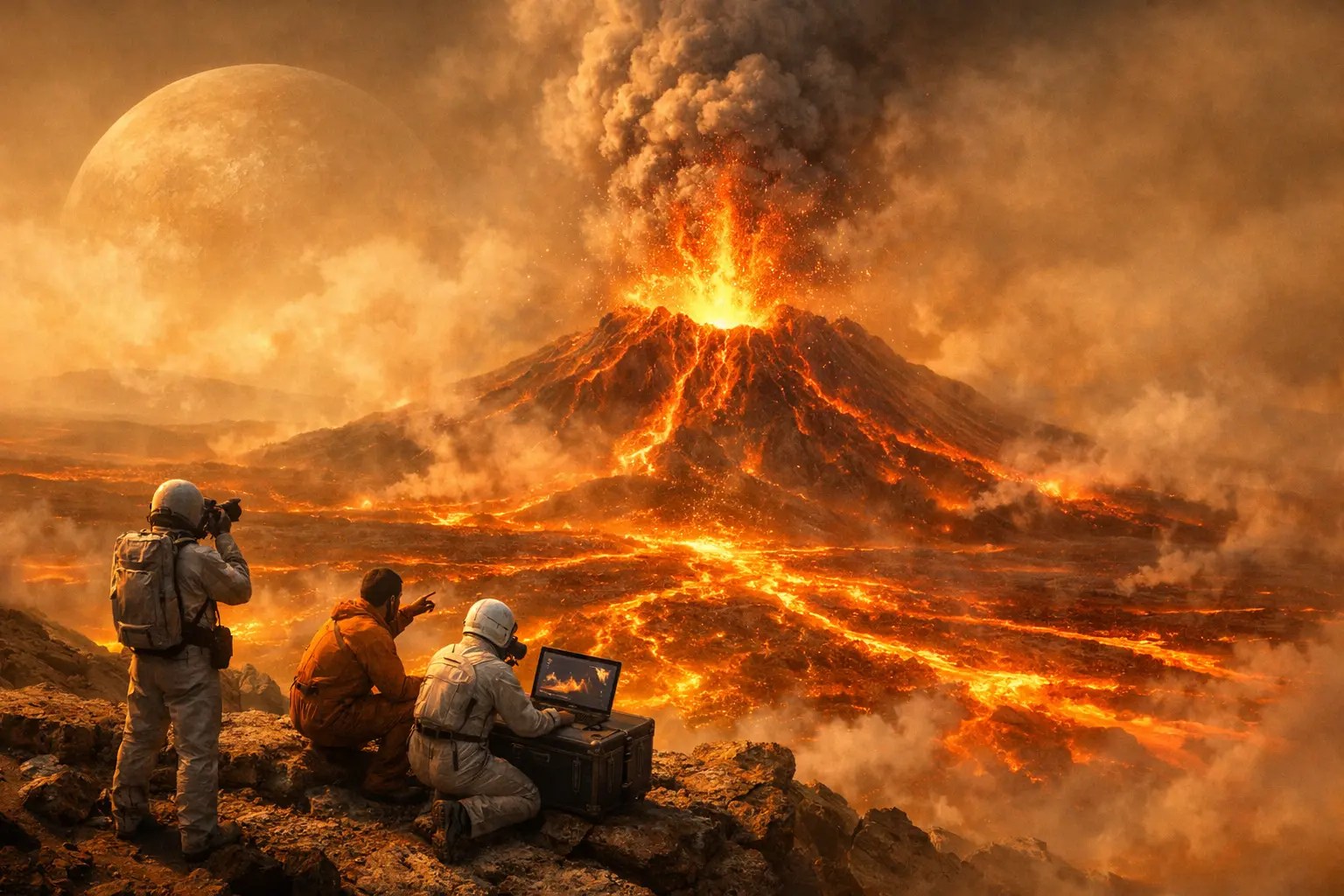
Active Volcanoes May Still Exist on Venus
Evidence from Lava Age and Atmospheric Composition
Scientists have long suspected that Venus, Earth’s scorching hot and acid-cloaked neighbor, may still harbor active volcanoes. New evidence suggests that lava flows on Venus’ surface may be just a few years old, bolstering the case for recent eruptions.
Hints of Volcanic Activity
Data from the European Space Agency’s Venus Express orbiter has revealed several clues of residual volcanic activity in Venus’ atmosphere. These include hotspots of intense heat and bursts of sulfur dioxide, a gas released by active volcanoes on Earth.
Lava Age Determination
Determining the age of lava flows on Venus from a distance is challenging. However, spacecraft have captured images of young-looking flows containing minerals that have not yet been chemically altered by the planet’s harsh conditions.
To better estimate the lava’s age, scientists recreated Venus’ extreme atmosphere in a laboratory using a box furnace. They exposed crystals of olivine, a common volcanic mineral, to temperatures exceeding 1,000 degrees Fahrenheit for varying durations.
Olivine rusts over time, changing from its greenish hue to a reddish-black color. This change makes it more difficult to detect by orbiting spacecraft. In the box furnace, the olivine rusted within days, suggesting that the lava on Venus could be less than a few decades old.
Laboratory Experiments and Future Missions
To validate their results, scientists are repeating their experiments with other minerals and using a more Venus-like atmosphere containing carbon dioxide and sulfur. Preliminary data from these experiments are promising.
The ultimate confirmation of Venus’ volcanic activity will come from future missions to the planet. These missions will be equipped to observe young lava flows and surface changes, providing concrete evidence of its recent activity.
Implications for Planetary Science
If Venus is indeed volcanically active, it would provide a unique opportunity to study the interiors of planets. Active volcanoes offer insights into the planet’s geological processes and the composition of its mantle.
Furthermore, understanding Venus’ volcanic activity could shed light on the evolution of our own planet, as Venus and Earth are thought to have shared similar early histories.
Additional Long-tail Keywords:
- Volcanic processes on Venus
- Olivine weathering experiments
- Planetary exploration
- Venus’ geological history
- Volcano monitoring techniques
- Astrobiology implications
- Remote sensing of Venus’ surface
- Volcanic hazards assessment
- Future planetary missions
- Earth-Venus comparisons
